Thursday, October 17, 2013

Final Project Proposal: Chin Wei & Nissa

Mood Bins

Project Intent:
There are two goals to this project. One, to encourage people to throw trash into bins. Second, to
leverage on people's desire to express themselves and influence their surroundings.

The idea was somewhat inspired by one of the Fun Theory projects that was posted at the beginning of the semester. We wondered if we could change people's behaviour positively by making it fun, could we make them to do the same by allowing them to express themselves?

The Looking Out projects and the feedback we've received throughout our development process of our whiskers made us realise the way people interact with our products is what gives it life. We wanted to build a product that was simple and could easily blend into people's consciousness. People throw trash all the time. What if we could from this action "see" the mood of people in the area?


Brief description:
The idea is to install two bins, side-by-side, in a place where people tend to hang out, like a school cafe or study area. One bin would be associated with "Happy" mood and the other with "Sad" mood, through the use of colours and decorations on the bin. As people throw trash in the "Happy" bin, it contributes to the happiness "score" in the room. Likewise, people throwing trash in the "Sad" bin would contribute to the "Sad" score.

When the score in one bin is higher than the score in another bin, the lighting in the area changes. When the room is more "Sad", the lights turn a bluish-hue. When it is "Happy", the lights turn to a yellowish-hue.

Additional thoughts:
We feel that the project presents an opportunity to explore certain aspects of people's behaviour.

For example, it would be interesting
  • to know the different kind of trash that enters into each bin. It is possible that the "Sad" bin will end up containing more articles that express frustration, such as crumpled drafts of work.
  • to see how people react to the current mood of the room. If the room is "Sad", will they attempt to make the room "Happier"? And in doing so, will it make them happier? Or will a "Sad" room drive people away?
  • to see if the mood of the room changes as we might expect it to. For example, would the room be "Sad" during finals?

Possible extensions of project:
  • to visualize the occurrence of "Sad" or "Happy" days across time, for example across a school semester
  • to create multiple sets of bins so we can map the mood across different places

Flow:
  • Sensor (Proximity?) detects trash entering bin
  • Arduino updates mood score and compares "Happy" and "Sad" score
  • If there is an overall change of mood, change the colour of the light
  • Save relevant data?
Logistics:
  • 2 Arduinos, one for each bin
  • For each Arduino,
    • 1 Proximity sensor - $5
    • Suitable batteries with battery attachments
    • SD card reader? (if necessary to do data logging) - $3
  • Wireless light bulb
  • 2 trash bins - $6-$25 each
  • Stuff to attach the electronics to the garbage bins
  • Stuff to decorate the bins
  • Garbage bags
Tentative Timeline:
Week Starting from Task
0 18 Oct Submit Project Proposal
1 21 Oct Order supplies / Work on prototype
2 28 Oct Finish proof of concept
3 4 Nov Install on trash can / get feedback
4 11 Nov Get feedback / Iterate
5 18 Nov Get feedback / Iterate
6 25 Nov Test
7 2 Dec Begin documentation
8 9 Dec Complete documentation

Wednesday, October 16, 2013

LookingOut 7: Liang

Project #1: Hotbot (2012)
By Eddi Lecesne


Hotbot is a robotic arm which can draw using heat. The concept is very simple: the air is sent from a balloon through a heated chamber. The thermal paper is the canvas and it draws textures on the paper when the air touch the paper and move above it. Besides, the installation consists of a macro-web camera which allows the user to scan his fingerprint or other things. This is then vectorized and drawn by Hotbot in its interpretation. I think the design is brilliant and the painting by heat is more of art.


Project #2: Vincent and Emily (2012)
By Carolin Liebl and Nikolas  


Vincent and Emily are two robots that show the viewer the solitude of a partner relationship and simultaneously the involvement of the partners in society and their impulses. Similar to humans, they depend for their communication on their sounds via loudspeakers and motions controlled by their motors.  The movement of the robots is realised by a pulling system, consisting of three motors whose rotation is transformed into a linear motion via gear wheels and gear racks. It is the elasticity of the moving metal shafts that make the robots' actions smooth and unpredictable. They capture sounds and movements via sensors and react on those signals with own expressions. For example, if Vincent sends positive signals by up and down movements, it is possible that Emily interprets even those signals as negative.  Emotions and thoughts are programmed. This project is a good simulations of humans' behaviours. It reflects the unpredictable interaction in our social relationships, intuitive and direct. 

Tuesday, October 15, 2013

Looking Out 6: Chinwei


Musical Laser Forests, Light Painting, and Quadcopters

by The Creators Project 


A number of very cool projects involving lights and lasers, by The Creators Project. Most of the projects shown in the video are extremely immersive experiences, and for projects such as the Musical Laser Forests, the audience is literally experiencing the performance from the inside. What is also interesting is the attempt across these to create a sense of warmth using technology. I especially like the Quadcopter light show which happens at about 03:16.

Sunday, October 13, 2013

LookingOut 5: Yang

Project #1 Tape Recorders 


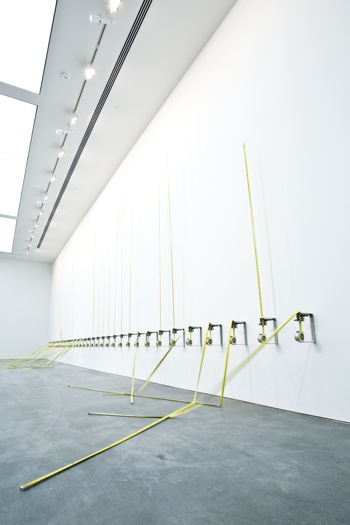
What is it: Rows of motorised measuring tapes record the amount of time that visitors stay in the installation. As a computerised tracking system detects the presence of a person, the closest measuring tape starts to project upwards. When the tape reaches around 3 meters high it crashes and recoils back. 

Technology: Camera, Stepper motors

Field: Tracker, Robotic


Value: It gives an interesting mapping between time and distance. However, the action of crashes seems unreasonable because it cuts visitors' time of stay into pieces for no reason. Also, the tape's falling cause people to dodge and scare them off, which makes no sense unless the inventor do not want a stayer. I come up with an idea to use this phenomenon to do something positive to people's health by encouraging them to move around after a long period of unhealthy working. The natural falling ability of the increasingly long tape results in an influence of people's unconscious level, which makes people to dodge. And it ends up with a healthy break. I want to make it in the class.

Project #2 : Voice Tunnel


What is it: “Voice Tunnel” is a large-scale interactive installation which transfers people's voice into the nightspots in a dark tunnel in the New York City. To use it, people press a button to record his/her voice and the light is lightened according to the volume of that voice in realtime. The voice is stored and played until the next player.

Technology:Voice recorder, Theatrical light

Field: Interactive Sound Light


Value: I thought it is just a magical visual design until I heard many positive voice recorded. People are so eager to have their voice heard or their mood expressed and the dim environment provides they a wonderful place to do so. The voices make the tunnel a narrative and a place full of story. Also, seeing others' light and others' voices can make them feel connected. That is truly a great feeling for people living in a big city.

Saturday, October 12, 2013

Zack's Looking Out: 10/12


Next level...


without us...


more organized...


and powerful.

Thursday, October 10, 2013

Squeaky Whisker v4


Overview


We took apart a printer and used its parts for materials to build an interactive whisker prototype. We found an unexpected surprise in the gears which create different sounds based on the materials applied to them.
Initially, users played with a spring to close a simple circuit which would turn the gears. They would place different materials along them to create different sounds which each seemed to take on a personality.

Our second iteration explored the look of the machine. We laser cut a cat-like mask out  of black acrylic  to "dress up" our little robot. Based on feedback we realized that leaving the raw parts exposed created a more honest and deliberate character.

Later we experimented with a different kind of input and ended up attaching a photo-resistor which spins the gears in proportion to the  amount of light in the environment, making it seem like the machine is scared of the dark.


Materials

  • Photo-resistor
  • Arduino Uno
  • Motor
  • 9V alkaline battery
  • 12V sealed lead-acid battery
  • Hacked printer parts
  • Foam base
  • Electronic components (breadboard, resistors, mosfet, wires, etc)

LookingOut 7: Liang

Project #1 Olars
by Lars Marcus Vedeler & Ola Vågsholm (Oslo School of Architecture and Design)


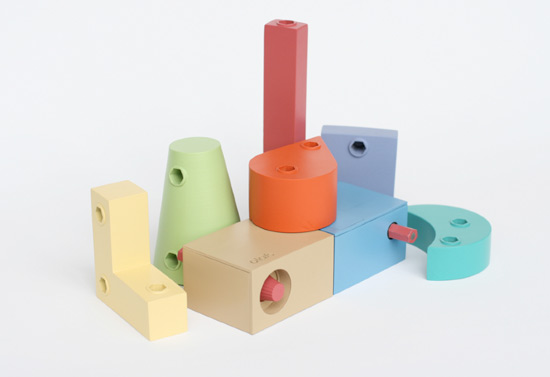
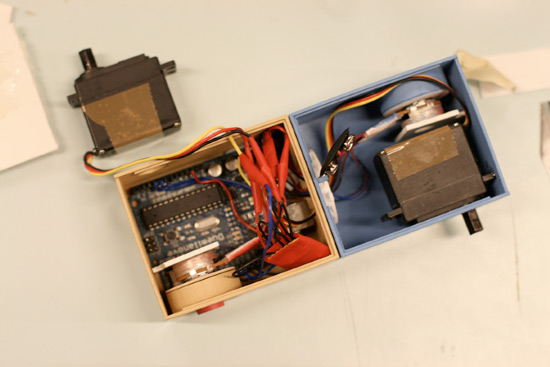
Olars is an interactive electronic toy consisting of a variety of colourful components that link together in different formations. It has thousands of varieties in movement and behaviours by attaching different geometrical limbs together, modifying the angle of these, twisting the body itself, and by adjusting the deflection of the motorised joints, results in both familiar and strange motion patterns. Each component has a different mechanical behaviour and can be fully animated. The core technology makes use of an Arduino Duemilanove board and two sets of a servo and switch. The value of Olars is, I think, to explore the geometrical knowledge by assembling blocks on hand.


Project #2 Spazzi
by BeatBot (article in Make)


This little toy to me is more like a brother of Keepon (a adorable and amazing toy years ago). It is a build-it-yourself dancing robot, incorporating off-the shelf solnoids and electronic components, an Arduino, and plastic parts that you can easily print on your 3D printers.


Here is the video of Keepon:

Looking out 4: Chin Wei


Telekinetic Coffee Shop Surprise


Using pulleys, remote controlled chairs and spring loaded books, these actors staged a convincing display of telekinesis that shocked the actual customers in the store.


Tuesday, October 8, 2013

Whisker Prototype 3


For the third version of our whisker, we aim to refine the sensors ( pressure sensing and light sensing) and the mechanic chains. When pressure and light light situation are presented, the petal will close. Forcing an opposite reaction from what the audience might expect.

During the implementation process, we figured that since we want the object like a flower, we have already form some anticipated outcome in our mind. However, if we could inverse the result and output an unexpected result, it will be more funny. Therefore, we add one more force sensor below the "leaf". We assume that if the object is very huge so that it could be a shelter for people. Then when people approach it, they may expect to avoid the sunshine or raindrops; but when they stand under the leaf, the leaf will close so that the sunshine will raindrops will directly falls on people's body.

In our next iteration, we would like to add some more shape transforms so that the "leaf" could be more flexible and "natural".


Looking Out

Aireal is created by Disney Research. The most attractive quality for me is that it provides tactile feelings therefore add on an interactive element for the audience. The interaction is tangible that users' body can feel it but it is not a direct visual experience as other experiences entail.


Whisker V4


Based on people's  feedback, we decided to make the camera's whisker longer, so people will be more likely to mess with it. We kept the photoresistor for now; although, we now know that covering the camera's eye is not something that people naturally want to do.

Whisker V3


We were disappointed when the second iteration of our whisker kept falling over during the demo, so the class's positive response to our whisker's disability was a pleasant surprise. We decided to keep the whisker slightly unstable and have it fall when its eye was covered, using a photoresistor to detect the low light. Unfortunately, the sensor was a bit too sensitive, so the whisker kept falling all over the place. The class wasn't able to discover why but had some fun messing around with the little guy who seemed to have broken free from whatever outlet he had been tethered to.

Looking Out : Maya

Tele-Present Water

By David Bowen


This installation replicates the movement of water in a remote location. It uses wave data collected in real time to simulate the movement of the water by controlling the joints of a grid structure suspended in air. The installation uses MAX/MSP to drive an Arduino mega.

I think the installation creates a very surreal experience. The idea of teleporting the movement of the ocean is very interesting; we're teleporting a motion, which is very abstract. The mapping out of this organic and natural motion on a large metallic, mechanical structure beautifully reinforces the process of projecting from one medium to another.


My Little Piece of Privacy 

By Niklas Roy


My little piece of Privacy is an interactive installation consisting of a robotic curtain that moves left and right to cover a large window whenever passerby's cross by. The project uses Processing for the computer vision and analysis, and a DC gear motor controlled by an Atmega for the mechanics.

I like the project because it embeds technology into a simple everyday use case. It’s interesting to see how adding a simple notion of interactivity to the curtain - reacting to the observer through motion - can really bring it alive. It makes me want to explore adding some interactivity to other ordinary objects and exploring how to give them their own character or personality. I also love the fact that the project engages with a public space such as pedestrians on a street.

Looking Out : Maya

DRM Chair

By - ECAL


DRM Chair is a chair that self-destructs after 8 uses. Sensors connected to the chair are able to detect every time someone sits on a chair.  The different joints of the chair are cast in wax and embedded with nichrome wire. After the 8th use, the joints are melted and the chair falls apart.

What I especially liked about this project is it illustrates the idea that an object is ephemeral and temporary. The object is no longer static, it has a controlled lifespan. It would be interested to actually visualize how objects evolve with use.  I also like that they chose to melt the joints, the fume coming out and wax melting is a very organic process, so the chair really does feel like its alive.


Ocean of Light

By - Squidsoup


Ocean of light is a digital controllable immersive medium where the space is filled with a grid of LEDs. Each LED module can be controlled to create amazing visual experiences. As people walk through the grid, the impression created is that of being immersed within an ocean. 

I love this project because it transports you to a different space. I like that they used the space as a physical medium; many times space is neglected and immersive experiences are simply projected onto a plane. I really think this project has more potential if user input is added. For instance, touching one LED could create ripples of light in the grid. Maybe people could interact by creating ripples that would intersect at some point.

http://www.creativeapplications.net/environment/shedding-light-on-squidsoup-a-conversation-with-anthony-rowe/

Whisker V1, V2 & V3: Liang, Wanfang and Ayo

INTRODUCTION
Tasked with the project of making a whisker for a 'chinchilla/human hybrid', we set off on an epic journey of discovering what it means to be a 'whisker'. The only constraint that guided our exploration was the requirement that the whisker retain sensitivity to a physical input.

VERSION 1


Our initial prototypes were created by exploring the materials within the immediate vicinity of the Code Lab. We sought to give form to a whisker that would respond to touch input. The image on the left was created from a wooden stick, zip ties, gel beads, and a modified plastic bottle. The idea behind its operation was to capture touch by bending the structure one way or the other.  
The image in the middle was created using a gear recycled from a rabbit, plywood, a metal rod, and three springs. The idea behind its operation was to capture touch input in the springs and use this energy to rotate the structure. One idea that was bandied around was to attach a pencil to the end of the whisker and have it record the touches imparted to it on paper. The advantage of this whisker was its pleasant one-to-one mapping between input(touch) and output (shape deformation). This property served as fodder for the third prototype.   

The third prototype embodied the form we imagined for a whisker that would respond to touch input. It was created using five springs, paper, and a metal rod. Because of its use of lightweight construction materials, it deformed quite pleasantly when touched and evoked a 'jello' metaphor. However, our desire for more interactivity inspired the future iterations of the whisker.


VERSION 2


After feedback from our peers, that our whisker reminded them of lunar modules, we shifted our design focus to explore this concept a little bit more. This design utilized acrylic and electronics to create a whisker that would light up in response to touch input. The shape of the whisker was designed to be hexagonal in order to allow the modular connection of an arbitrary number of these whisker modules.


VERSION 3


Further feedback from our peers revealed that while the second iteration was enjoyable, it lost the interactive capabilities of the initial prototype. Thus, we sought to integrate these capabilities into this final version. We utilized 3d-printed parts (to make the structure more flexible than acrylic), a ping-pong ball to (diffuse the integrated LED and add a level of interactivity), a coil of wire, and four springs. While retaining the lunar module feel of the previous iteration, interactivity was added by programming behaviors into the whisker. Upon initial touch, the whisker emits a cool blue light, a sort of welcome to the user. If the whisker is still held for a period longer than approximately 2 secs, the whisker proceeds to emit a pulsing green light that signifies it is communicating with either the user, or another module. Now, if the whisker is bent or deformed from its original straight orientation, it emits a red light and begins to vibrate signifying that it is uncomfortable and angry. These additional behaviours breathed new life into the whisker, transforming it from a simple input-output sensor, to a seemingly complex thing with emotions and motivations.

Hardware: Teensy 2.0, Whisker(Wires), RGBLED, Motor, CapacitiveSensor is a library in Arduino, just using a wire and a large resister (10MOhm) can let the Teensy (Can write code in Ardunio) to get
analog signal of touch.


Design process video:

Final version demo:

CONCLUSION
We present a series of iteration processes for designing a whisker. Along with the process and calendar addressed in MTI, we practice sketch design, prototyping, laser cutting and 3D printing. To make whisker interactive, we also put some sensor technology there and produce digital outputs. The next step for this prototype focuses on two aspects:
1. Shape redesign.
2. Multiple whiskers communication.

Links:
Fabrication Package: https://github.com/EdigaHe/Whisker-Fabrication-Source-Files/tree/master
Capacitive Sensor: http://mtif13.blogspot.com/2013/10/about-capacitivesensor-in-ardunio.html 
Teensy: https://www.sparkfun.com/products/11780
Teensy Source Code: https://github.com/wfdiao/CapacitiveSensorForArduinio/blob/master/CapacitiveSensorSketch/CapacitiveSensorSketch.ino

Keep In Touch - Whisker Process and Experimentation : Austin McCasland


I put together this video of the progression of my whisker and my explorations down the rabbit hole.  I've titled the video "Keep in Touch" with accompanying music by Maximum Hedrum in the spirit of whiskers.