Inspired by Disney’s Botanicus Interacticus project, our project aims to explore how plants might react to human presence and touch, and also, how people would react to plants that responds to them.
Mood Bins Project Intent:
There are two goals to this project. One, to encourage people to throw trash into bins. Second, to
leverage on people's desire to express themselves and influence their surroundings.
The idea was somewhat inspired by one of the Fun Theory projects that was posted at the beginning of the semester. We wondered if we could change people's behaviour positively by making it fun, could we make them to do the same by allowing them to express themselves?
The Looking Out projects and the feedback we've received throughout our development process of our whiskers made us realise the way people interact with our products is what gives it life. We wanted to build a product that was simple and could easily blend into people's consciousness. People throw trash all the time. What if we could from this action "see" the mood of people in the area?
Brief description:
The idea is to install two bins, side-by-side, in a place where people tend to hang out, like a school cafe or study area. One bin would be associated with "Happy" mood and the other with "Sad" mood, through the use of colours and decorations on the bin. As people throw trash in the "Happy" bin, it contributes to the happiness "score" in the room. Likewise, people throwing trash in the "Sad" bin would contribute to the "Sad" score.
When the score in one bin is higher than the score in another bin, the lighting in the area changes. When the room is more "Sad", the lights turn a bluish-hue. When it is "Happy", the lights turn to a yellowish-hue.
Additional thoughts:
We feel that the project presents an opportunity to explore certain aspects of people's behaviour.
For example, it would be interesting
to know the different kind of trash that enters into each bin. It is possible that the "Sad" bin will end up containing more articles that express frustration, such as crumpled drafts of work.
to see how people react to the current mood of the room. If the room is "Sad", will they attempt to make the room "Happier"? And in doing so, will it make them happier? Or will a "Sad" room drive people away?
to see if the mood of the room changes as we might expect it to. For example, would the room be "Sad" during finals?
Possible extensions of project:
to visualize the occurrence of "Sad" or "Happy" days across time, for example across a school semester
to create multiple sets of bins so we can map the mood across different places
Flow:
Sensor (Proximity?) detects trash entering bin
Arduino updates mood score and compares "Happy" and "Sad" score
If there is an overall change of mood, change the colour of the light
Save relevant data?
Logistics:
2 Arduinos, one for each bin
For each Arduino,
1 Proximity sensor - $5
Suitable batteries with battery attachments
SD card reader? (if necessary to do data logging) - $3
Wireless light bulb
2 trash bins - $6-$25 each
Stuff to attach the electronics to the garbage bins
Based on people's feedback, we decided to make the camera's whisker longer, so people will be more likely to mess with it. We kept the photoresistor for now; although, we now know that covering the camera's eye is not something that people naturally want to do.
We were disappointed when the second iteration of our whisker kept falling over during the demo, so the class's positive response to our whisker's disability was a pleasant surprise. We decided to keep the whisker slightly unstable and have it fall when its eye was covered, using a photoresistor to detect the low light. Unfortunately, the sensor was a bit too sensitive, so the whisker kept falling all over the place. The class wasn't able to discover why but had some fun messing around with the little guy who seemed to have broken free from whatever outlet he had been tethered to.
In this iteration we decided to continue with the idea of our whisker being some sort of exploration bot. In order to give our whisker more life, we decided that it needed to be able to survive without being attached to a clamp, so we added a platform and wheels. While it's not quite working the way it would ideally, our camera whisker now has a motor and servo so it can move and turn. Only two of the original whiskers remain, and the interaction with them has changed since we have made our whisker mobile. These whiskers make the camera turn when they are hit.
Adding wheels to our whisker may not have been the most imaginative thing for us to do. We all thought it was the next logical step. However, adding the wheels has opened up a lot of possibilities, and now we have to figure how our whisker is going to interact with its environment as it moves about. Our whisker is a camera, so we would also like to make use of the fact that it seems to have a giant eye.
We spent a good amount of time working and reworking this iteration. Some photos of the process are below.
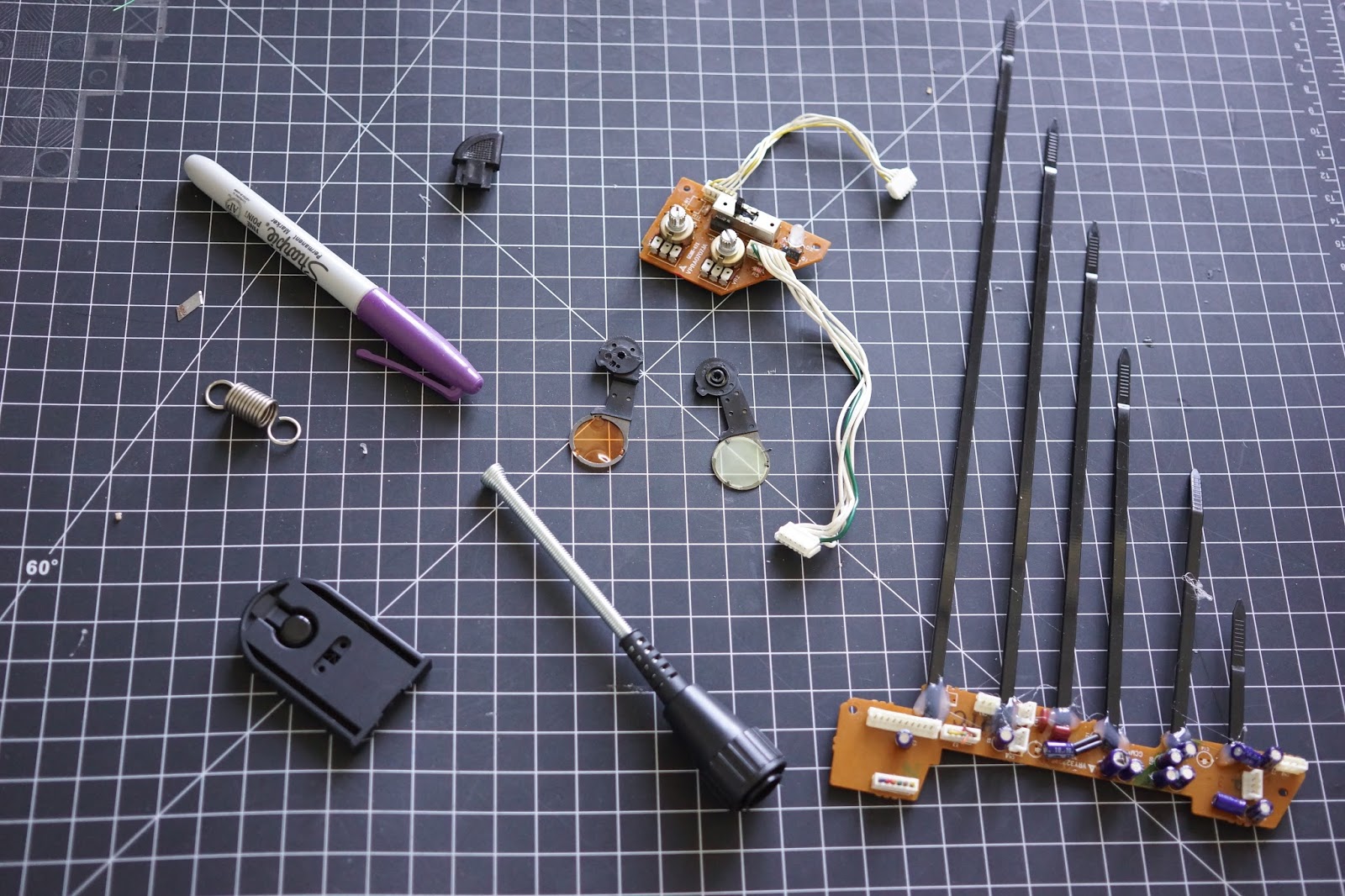
For the first iteration of our whiskers, we dismantled an old digital video camera and repurposed the frame as a body. The frame had an awkward shape which made it impossible to stand upright by itself. However after we attached the frame to a clamp and oriented the lens horizontally, it began to look like some sort of a mechanical creature with a big eye.
We decided that 'whiskers' in this context could be literal; We could have long, thin sensors sticking out underneath, to the side of the 'face' and on the top of the frame, resembling the moustache and hair of a human, the whiskers of an animal. Following that, we wired the moustache to trigger LEDs when they are pushed from the side.
What I see it as: A cat that makes noise when you flick its
whisker and makes other noises when you poke its eyeball with stuff.
What I imagine it becoming: A mouth that nibbles at stuff,
delighting everyone nearby with its musical mastication; though, how
whisker-like is that really?
Andre, Gaby, and Maya’s sound-making whisker has changed a
lot since A2. It is now much more compact, which makes it much more portable. However,
I think it has less presence before. There was also something a bit charming about
its rawness in the first iteration. Now, I think it’s in an uncomfortable place
between raw and finished, but it is a work in progress. The whisker now has a
face and is recognizable as a creature head. I think that it was interesting
that the group chose to make their whisker into something recognizable. The
laser cut pieces look very nice aside from a few rough edges. I think it is
interesting how adding the face has changed the interaction. People are less
likely to poke at the gears through the eye sockets to make different noises,
but the creature is sensitive to physical output and reacts in a way a real
creature might.
Chinwei
The new compact form factor and portability is the most obvious change in this iteration. The next obvious change is that this whisker is starting to resemble the eyes of a face, with the nose being the primary sensing organ and the eyes being the primary feedback. Aside from the fact that this it is now less convenient to stick something into the moving gears, there is a resistance to wanting to stick something into the "whisker's" eyes, as if someone could potentially hurt it by doing that.
Somewhat lacking in this current iteration of whiskers is a proper platform for it to elevate itself to a certain height to more convincingly appear like a face. In its current state, the entire mechanism is too low on the ground to be accessible to humans touching it. Also, the sensors (the nose) is a bit small considering it is acting as a touch sensor for the rest of the face.
Despite that however, once the mode of interaction becomes clear, feeding the gears with various materials and playing with the 'nose' to produce a sound is both exploratory and experiential.
Tropism Well is an
interactive sculpture created by designers Richard Harvey and Keivor John in
2011. When the Tropism Well is approached,
water begins to pump up its neck and fill the pitcher at the top. As the pitcher
fills, the well slowly and gracefully bends from the weight. Once it has bent
all the way over, the Tropism Well
will pour you a drink.
What fascinates me the most about the Tropism Well is how much it seems like a living thing. The way it bends
seems so natural, and the action of pouring you a glass of water makes it seem
kind and helpful. In the video you can see that the people interacting with the
well feel this same way, with some even thanking it for the water.
Submergence an
interactive space created by Squidsoup, a group of international interactive
media artists, at Galleri ROM in Oslo during January and February 2013. Submergence is made out of over 8,000 lights
hanging from the ceiling, creating 3D matrices of light. Visitors interact with
moving light objects in the space as a Kinect tracks their movements.
I think that Submergence is interesting because it seems to
take you to an alternate reality and creates the illusion of physical objects and
creatures using light.
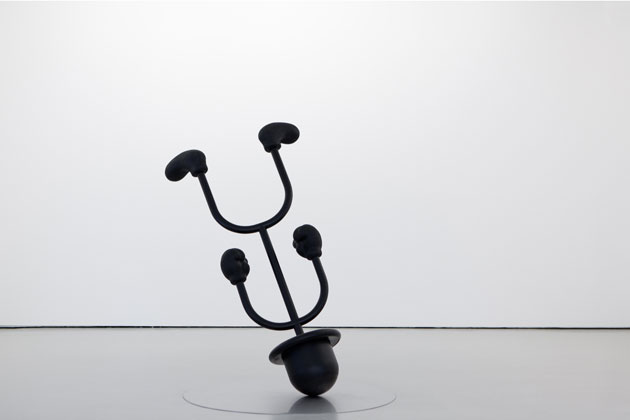
Heavy Hat is a
sculpture of a man balanced upside-down on his heavy hat. In the presence of
humans, Heavy Hat begins to sway back
and forth in an unpredictable manner. In order to engage spectators, the
sculpture dips down low, appearing to be falling, and hopefully, people will
instinctively reach out to catch it, though the sculpture is designed to always
keep its balance.
I love that Heavy Hat takes advantage of people’s
instinctual behavior. People interact with the sculpture not really because
they want to, but because they almost have to.
Pygmies consists
of 25 panels behind which over 500 small black “pygmies” live. The Pygmies are sensitive to sound, hiding
when it is loud and slowing peeking out from behind the panel when it is quiet.
The Pygmies were designed to be
lifelike so they adjust to ambient noise and all behave slightly differently
from each other.
I think Pors & Rao did a very good job at making Pygmies seem lifelike. Their smallness
and timidity make them very cute and likeable, and it doesn’t surprise me that people
who saw this treated them playfully and like real creatures.
Go to 4:45 for Heavy
Hat and 1:50 for Pygmies. If you
watch the rest you
can see 6 more of Pors & Rao’s works from their show
Applied Fiction.