Ba.S.I.S from Amy Friedman on Vimeo.
Showing posts with label amyfriedman. Show all posts
Showing posts with label amyfriedman. Show all posts
Saturday, December 21, 2013

Monday, December 16, 2013
Whisker V4 to V1: Amy
Whisker 1:

materials:
from a lamp
-copper wire
-spring
-screws
-weight
-plastic
The main properties of the first part of my whisker is its magnetic attraction, as a response to its own surrounding. In essence the whisker acts as an antenna to send out electromagnetic signals to allow for an animal to respond to a predator that is nearby.
Whisker 2:

materials:
-magnets
-acrylic
-metal I-hook
-wood rod
V2 takes the electromagnetic response further to allow for the head to move out and in based on magnetic attraction. This begins to incorporate a defense mode which would be move manually to attack the predator and try to catch their hand as they approached the stationary whisker. The value changed from V1 to V2 is that the object is scaled up and the magnetic attraction is continued, but the whisker still lacks a greater overall interaction for users. There is also a lack of determination as to the definition of the whiskers goals overall and how it wants to react.
Whisker 3:

 materials:
-cardboard
-acrylic
-servo motor
-magnets
-wood rod
-ardunio
-elastic band
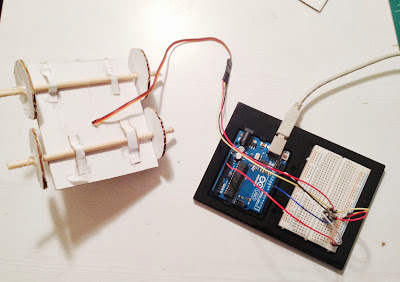
Whisker V3 has modifications that integrate a servo motor into the claw part of the whisker. When a magnetic force is need the whisker it tries to push itself away through opposing magnetic forces. If someone gets to close the claw spins based on a simple servo coding (no sensors used) and the claw can be shut and opened through manual pulling and pushing of a rubber band. This modification continues to focus on self defense as you approach the whisker. It begins to resemble a toy and allows the user to interact with it further.
Whisker 4:

from a lamp
-copper wire
-spring
-screws
-weight
-plastic
The main properties of the first part of my whisker is its magnetic attraction, as a response to its own surrounding. In essence the whisker acts as an antenna to send out electromagnetic signals to allow for an animal to respond to a predator that is nearby.
Whisker 2:

materials:
-magnets
-acrylic
-metal I-hook
-wood rod
V2 takes the electromagnetic response further to allow for the head to move out and in based on magnetic attraction. This begins to incorporate a defense mode which would be move manually to attack the predator and try to catch their hand as they approached the stationary whisker. The value changed from V1 to V2 is that the object is scaled up and the magnetic attraction is continued, but the whisker still lacks a greater overall interaction for users. There is also a lack of determination as to the definition of the whiskers goals overall and how it wants to react.
Whisker 3:

-cardboard
-acrylic
-servo motor
-magnets
-wood rod
-ardunio
-elastic band
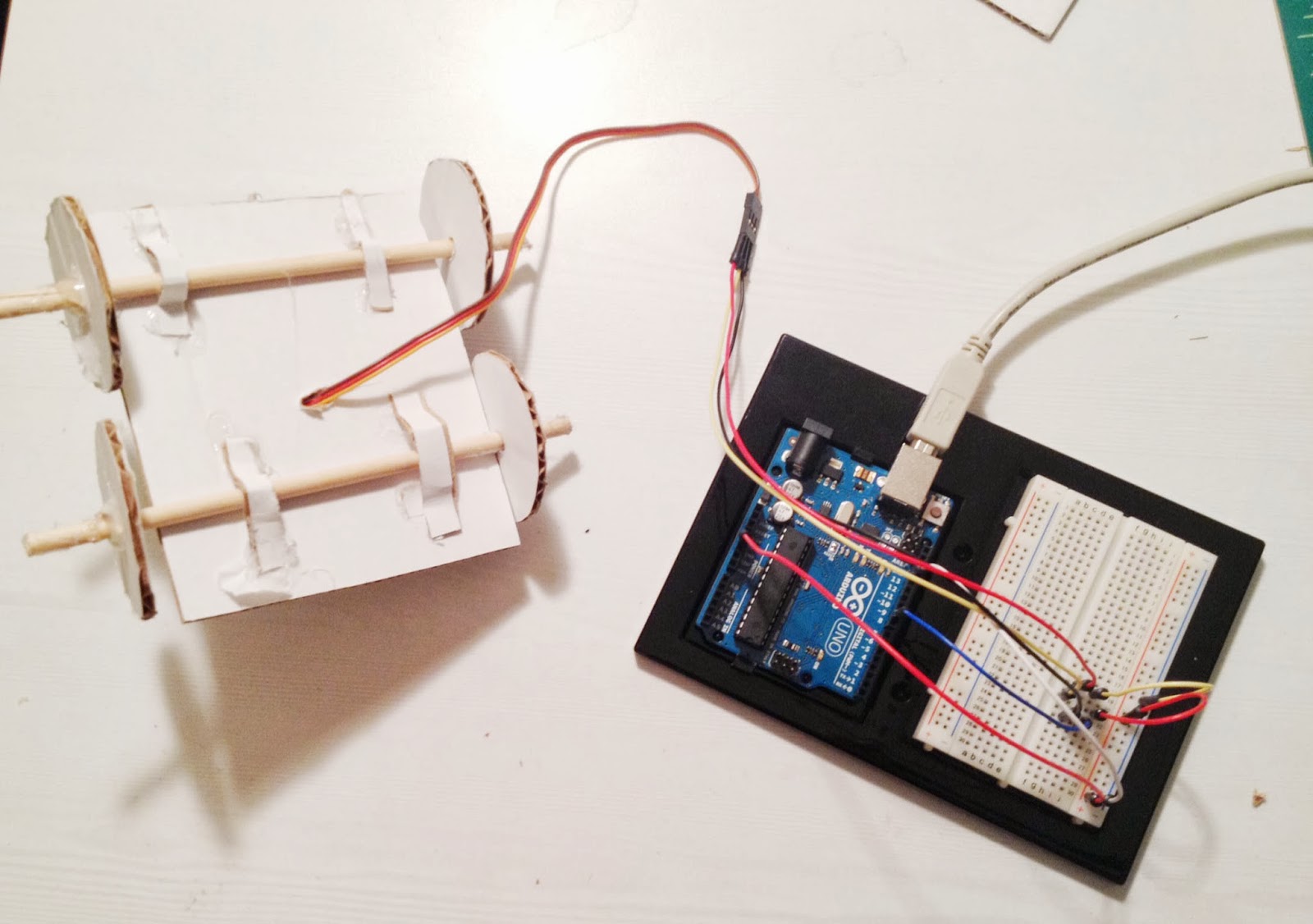
Whisker V3 has modifications that integrate a servo motor into the claw part of the whisker. When a magnetic force is need the whisker it tries to push itself away through opposing magnetic forces. If someone gets to close the claw spins based on a simple servo coding (no sensors used) and the claw can be shut and opened through manual pulling and pushing of a rubber band. This modification continues to focus on self defense as you approach the whisker. It begins to resemble a toy and allows the user to interact with it further.
Whisker 4:
Whisker V.4 from Amy Friedman on Vimeo.


 materials:

-Fishing Wire

-Metal Wire-Wood Rod

-Acrylic

-Servo Motor

-LED Light

-DC Motor

-Buzzer

-PIR Sensor

-Ardunio


This final whisker prototype adds a greater interactive element as V4 reacts to motion. With all of its electronic features, it gives the whisker a personality that was lacking before. I learned that inorder for something to truly be interactive there needs to be a strong curiosity. One may know what it is made of, but the user still may want to explore what it can further active over time. When V4 is activated, it first lights up its LED, signifying that it is awake. Then he turns his head around overseeing his surroundings, and understanding what woke him up. After finishing his surveillance, he lets out a high pitched alarm signifying his scream of terror, and tries to get away but inevitably cant move. There is something different in the way we interact with a bow & arrow or clamp vs a "cute" toy as some may declare this to be. And it was a great lesson to learn about both through my prototyping.
Monday, December 9, 2013
"Ba.S.I.S." Final Project: Amy
Ba.S.I.S. - Volleyball Skill Identification System


Statement:
Ba.S.I.S., is a volleyball skill identification system. The project itself is a glove that is worn on the right hand and allows anyone to play volleyball and learn how to accurately execute each skill. Through an analog output of 3 sensors, the information will indicate to the user whether they BUMP, SET or SPIKE.
Short tech description:
FSR Sensor
Flex Sensor
Softpot Position Sensor
Arduino (analog output)
Processing (visualization of output)
Acknowledgements:
Zack Jacobson-Weaver
Dale Clifford
Mauricio Contreras
Tuesday, November 12, 2013
Monday, October 28, 2013
Looking Out 6: Amy
Nike Fuel Band
http://www.nike.com/us/en_us/c/nikeplus-fuelband

http://insider.nike.com/us/launch/nike-fuelband/
The Nike Fuel Band is an interesting product as it was developed to track the everyday activity of anyone. This project was geared towards the average man to allow him to have a device that helps prioritize physical activity in everyday life. The fuelband further allows users to reach out to a network to gain motivation from others. The band can be connected to any smartphone by bluetooth, after downloading the free Nike Fuel App. The fuel settings are customized to your age, weight, height, and you set your own fuel goal based on what you want to achieve. There are four settings shown on the band itself; Fuel, Calories, Steps and Time.
This Technology allows people to become aware of the lack or good amount of activity that they experience on a daily basis, and this device helps build awareness to what they should and can achieve.
Technology:
2 Lithium Polymer Batteries(3.7V)
20 color red/green LED
100 white LED
Stainless Steel
Magnesium
Thermoplastic Elastomers
Polypropylene
Bluetooth Connectivity
Pedometer
http://en.wikipedia.org/wiki/Nike%2B_FuelBand#Specifications
http://www.nike.com/us/en_us/c/nikeplus-fuelband

http://insider.nike.com/us/launch/nike-fuelband/
The Nike Fuel Band is an interesting product as it was developed to track the everyday activity of anyone. This project was geared towards the average man to allow him to have a device that helps prioritize physical activity in everyday life. The fuelband further allows users to reach out to a network to gain motivation from others. The band can be connected to any smartphone by bluetooth, after downloading the free Nike Fuel App. The fuel settings are customized to your age, weight, height, and you set your own fuel goal based on what you want to achieve. There are four settings shown on the band itself; Fuel, Calories, Steps and Time.
This Technology allows people to become aware of the lack or good amount of activity that they experience on a daily basis, and this device helps build awareness to what they should and can achieve.
Technology:
2 Lithium Polymer Batteries(3.7V)
20 color red/green LED
100 white LED
Stainless Steel
Magnesium
Thermoplastic Elastomers
Polypropylene
Bluetooth Connectivity
Pedometer
http://en.wikipedia.org/wiki/Nike%2B_FuelBand#Specifications
Final Project Proposal: Amy
Sensored Sports Ball for Coordination Development
Ideal Project:


http://www.ducksters.com/sports/football/throwing_a_football.php
http://www.thecompletepitcher.com/pitching_grips.htm
problem
A major problem when it comes to playing sports or learning a new sport, is the constant jamming of the fingers, simple injuries that could be solved with the correct hand-eye coordination development.
solution
This idea could be applicable to any sports ball whether that be football, volleyball, baseball, etc. The ball would be lined with an infrared sensor layer that could create a virtual imprint of an athletes hand placement on the ball. The information would be wirelessly sent to a computer, to allow athletes to easily preview their "imprint". Another aspect of the sensor layer is that it would have a force sensor, and calibrator to calculate the force that the ball hits each finger with or the force that the finger hits the ball with. This information would be sent to the computer, computed through a program, and output directions to athletes to help improve their ball control. Programs will need to be developed with standards for each sport. In order for the program to be successful I would need to gather enough information to create a control which all variable data can be calculated against. I would also want the ball to be able to understand the wind patterns, and the temperature, and use these variables to help improve an athletes adjustment to surroundings.

 http://www.imaging1.com/thermal/thermoscope-FLIR.html
application
The output would allow athletes to improve their source of error when it comes to their given sport. It will also allow for less injury to athletes, and gives personalized feedback, when a coach may be focusing on another play. This is applicable for someone who wants to improve their skillsets and learn the right way to play a sport, rather than someone who is playing for fun.
Reality:
I will create a volleyball that will record data of what is happening to it. There are 3 variables that I will track to understand the data I receive. The 3 tracks are: set, spike and serve. I will need to learn Zigbee and I will need to teach myself to pipeline the data I receive from the arduino and send it to Processing to visualize the data.
Things I will need:
-Volleyball
- Zigbee
- Pressure Sensors
-Accelerometer
-MPR121 Capacitive Touch Sensor
Areas to Research:
-sports medicine
-interaction design
-athlete sensor data
-tracking athletic movement
Ideal Project:


http://www.ducksters.com/sports/football/throwing_a_football.php
http://www.thecompletepitcher.com/pitching_grips.htm
problem
A major problem when it comes to playing sports or learning a new sport, is the constant jamming of the fingers, simple injuries that could be solved with the correct hand-eye coordination development.
solution
This idea could be applicable to any sports ball whether that be football, volleyball, baseball, etc. The ball would be lined with an infrared sensor layer that could create a virtual imprint of an athletes hand placement on the ball. The information would be wirelessly sent to a computer, to allow athletes to easily preview their "imprint". Another aspect of the sensor layer is that it would have a force sensor, and calibrator to calculate the force that the ball hits each finger with or the force that the finger hits the ball with. This information would be sent to the computer, computed through a program, and output directions to athletes to help improve their ball control. Programs will need to be developed with standards for each sport. In order for the program to be successful I would need to gather enough information to create a control which all variable data can be calculated against. I would also want the ball to be able to understand the wind patterns, and the temperature, and use these variables to help improve an athletes adjustment to surroundings.


application
The output would allow athletes to improve their source of error when it comes to their given sport. It will also allow for less injury to athletes, and gives personalized feedback, when a coach may be focusing on another play. This is applicable for someone who wants to improve their skillsets and learn the right way to play a sport, rather than someone who is playing for fun.
Reality:
I will create a volleyball that will record data of what is happening to it. There are 3 variables that I will track to understand the data I receive. The 3 tracks are: set, spike and serve. I will need to learn Zigbee and I will need to teach myself to pipeline the data I receive from the arduino and send it to Processing to visualize the data.
Things I will need:
-Volleyball
- Zigbee
- Pressure Sensors
-Accelerometer
-MPR121 Capacitive Touch Sensor
Areas to Research:
-sports medicine
-interaction design
-athlete sensor data
-tracking athletic movement
Saturday, October 5, 2013
Looking Out 5: Amy
Topic: Sense of Touch
1. Microsoft Multi-Touch Sphere
People: Hrvoje Benko, Andy Wilson, Ravin Balakrishnan, Billy Chen
Materials: sensors, diffused sphere, projection, LEDs
applications which the sphere possesses are:
omni-directional video-conferencing application, finger painting, picture and video browser, interactive globe visualization
information from http://research.microsoft.com/en-us/um/people/benko/projects/sphere/
Interaction: people can play and use the sphere to learn new details about topics in museums, schools, libraries. This product allows for "play" and "touch" to be integrated into learning and adds another human sense into the learning process we experience each day.
2. Paradox Beach Interactive Installation
information from http://blog.emptyfield.com/2006/11/paradox-beach-interactive-installation.html
components: sound, video tracking technology, floor video projection
Projected onto the floor and children can drag and touch the ground to move the interactive components of the installation. Children use their bodies to learn. In this installation, they learn about numbers.

"With simple rules a computer animates graphic forms so they react to people. Children make decisions with their bodies and their minds, as they navigate through a story. Our recent experience with learning games tells us that kinds benefit from the sophistication of "adult" work combined with an honest, direct approach to stories and goals. We make these works for the kind of kids we were: curious, thoughtful and challenging."
quoted from http://blog.emptyfield.com/2006/11/paradox-beach-interactive-installation.html
This installation is interesting as it allows children to explore learning through moving and touching. They learn more by using more of their senses. Video games use a similar idea to make learning fun, but allowing the children to move and run allows them to further retain the information as they enjoy the experience and it doesnt appear to be "book learning".
The Sphere and this installation can help initiate the important of physical activity at a young age. Teaching through interactive components further associates information with "fun" and therefore children can continue the importance of exercise based on what they learned as kids. Trying to find new ways of working out through an inspiration and give-back component.
1. Microsoft Multi-Touch Sphere
People: Hrvoje Benko, Andy Wilson, Ravin Balakrishnan, Billy Chen
Materials: sensors, diffused sphere, projection, LEDs
applications which the sphere possesses are:
omni-directional video-conferencing application, finger painting, picture and video browser, interactive globe visualization
information from http://research.microsoft.com/en-us/um/people/benko/projects/sphere/
2. Paradox Beach Interactive Installation
information from http://blog.emptyfield.com/2006/11/paradox-beach-interactive-installation.html
components: sound, video tracking technology, floor video projection
Projected onto the floor and children can drag and touch the ground to move the interactive components of the installation. Children use their bodies to learn. In this installation, they learn about numbers.

"With simple rules a computer animates graphic forms so they react to people. Children make decisions with their bodies and their minds, as they navigate through a story. Our recent experience with learning games tells us that kinds benefit from the sophistication of "adult" work combined with an honest, direct approach to stories and goals. We make these works for the kind of kids we were: curious, thoughtful and challenging."
quoted from http://blog.emptyfield.com/2006/11/paradox-beach-interactive-installation.html
This installation is interesting as it allows children to explore learning through moving and touching. They learn more by using more of their senses. Video games use a similar idea to make learning fun, but allowing the children to move and run allows them to further retain the information as they enjoy the experience and it doesnt appear to be "book learning".
The Sphere and this installation can help initiate the important of physical activity at a young age. Teaching through interactive components further associates information with "fun" and therefore children can continue the importance of exercise based on what they learned as kids. Trying to find new ways of working out through an inspiration and give-back component.
Whisker V3: Amy
V3 Whisker:
materials: wood, cardboard, acrylic, servo motor
Whisker V3 has modifications that integrate a servo motor into the claw part of the whisker. When a magnetic force is need the whisker it tries to push itself away through opposing magnetic forces. If someone gets to close the claw spins based on a simple servo coding (no sensors used) and the claw can be shut and opened through manual pulling and pushing of a rubber band.


Thursday, October 3, 2013
Looking Out 4: Amy
Topic: Luminance
1. Eye-Controlled Lights
Created by: Michael Kohút
materials: glasses, electronics, sensors
The installation matches the speed at which a person blinks. When the user wears the glasses and blink, the light shuts off. The user and others around them may never notice that there was a change when the wearer blinked as it happens very quickly at times.
Kohút says, "In the moment when someone wears the glasses, he or she is becoming a part of the machine. They don’t notice anything; they just start a performance for the rest of the audience. Sometimes no one notices the point, but this is also part of the experience."
quoted from http://blog.zennioptical.com/blink-through-someone-elses-eyes/
video can be found http://vimeo.com/45921590
Interaction: As stated above the person is the performance, as they blink they turn the lights on and off. This is a fascinating concept for someone to be the installation. Also I question the extent to which someone would notice the lights turning on and off. When my eyes are closed and the lights are on I can sense there being light, and when they are off that glowing essence isnt there. Wouldnt the users experience that too while holding their eyes down for a bit.
Future: This would be interesting to test and manipulate objects at the speed of a blink as it occurs very quickly.
2. Smart Highway
"not about new technology and new designs, its about creating new mental maps and pushing people to think about the future" quoted from video http://www.studioroosegaarde.net/project/smart-highway/
created by: Studio Roosegaarde
materials: motion sensors, paint
Interactive and Sustainable Environment
idea is to help develop roadways to be more safe for drivers. If the ground is icy, when its cold enough a symbol will show up indicating the ice. At night time paint can be manipulated to glow and become clearer so drivers dont depend only on reflectors on the ground. Finally as one drives by there can be lights that light the path based on motion sensors. As stated above these ideas arent new technology but rather guiding people to think about other aspects of our environment to develop. This technology should be installed in the Netherlands by Nov 2013.
 image and information source: http://www.studioroosegaarde.net/project/smart-highway/photo/#smart-highway
Future: This idea of "new mental maps" can be applied to the way in which people think about physical activity and what we find important to improve upon. Studio Roosegaarde makes a valid point in their video, that we focus on improving cars, but pay not attention to the way we can improve roads. This thought process can be applied to the prioritization humans give to specific tasks daily. Rather than eating healthy and being in shape, we just do work to pay the bills and support ourselves without an inbetween at times.
1. Eye-Controlled Lights
Created by: Michael Kohút
materials: glasses, electronics, sensors
The installation matches the speed at which a person blinks. When the user wears the glasses and blink, the light shuts off. The user and others around them may never notice that there was a change when the wearer blinked as it happens very quickly at times.
Kohút says, "In the moment when someone wears the glasses, he or she is becoming a part of the machine. They don’t notice anything; they just start a performance for the rest of the audience. Sometimes no one notices the point, but this is also part of the experience."
quoted from http://blog.zennioptical.com/blink-through-someone-elses-eyes/
video can be found http://vimeo.com/45921590
Interaction: As stated above the person is the performance, as they blink they turn the lights on and off. This is a fascinating concept for someone to be the installation. Also I question the extent to which someone would notice the lights turning on and off. When my eyes are closed and the lights are on I can sense there being light, and when they are off that glowing essence isnt there. Wouldnt the users experience that too while holding their eyes down for a bit.
Future: This would be interesting to test and manipulate objects at the speed of a blink as it occurs very quickly.
2. Smart Highway
"not about new technology and new designs, its about creating new mental maps and pushing people to think about the future" quoted from video http://www.studioroosegaarde.net/project/smart-highway/
created by: Studio Roosegaarde
materials: motion sensors, paint
Interactive and Sustainable Environment
idea is to help develop roadways to be more safe for drivers. If the ground is icy, when its cold enough a symbol will show up indicating the ice. At night time paint can be manipulated to glow and become clearer so drivers dont depend only on reflectors on the ground. Finally as one drives by there can be lights that light the path based on motion sensors. As stated above these ideas arent new technology but rather guiding people to think about other aspects of our environment to develop. This technology should be installed in the Netherlands by Nov 2013.

Future: This idea of "new mental maps" can be applied to the way in which people think about physical activity and what we find important to improve upon. Studio Roosegaarde makes a valid point in their video, that we focus on improving cars, but pay not attention to the way we can improve roads. This thought process can be applied to the prioritization humans give to specific tasks daily. Rather than eating healthy and being in shape, we just do work to pay the bills and support ourselves without an inbetween at times.
Monday, September 30, 2013
Looking Out 3: Amy
Topic: Nearness
1. Nearness
created by: Touch, BERG
"One of the essential properties of Near Field Communication is nearness, but this is set against one of the paradoxes of touch-based interaction where, in fact, nothing needs to touch. In a very short film made with BERG, we explore nearness in interactive technologies."
quoted from http://www.nearfield.org/2009/09/nearness
video http://vimeo.com/6588461
Interaction/Future: The nearness could be developed into moblie apps which allow for people to interact with ordinary objects by using their phones. Nearness creates a new insight into what touching means and how something can be manipulated to react without direct contact.
2. Quirky Wallbrights
Designed by: Debra Courtenay
Materials: Plastic, LED, Adhesive
Wallbrights combine LED's and wall decals together through an adhesive backing. The LEDs are lineked through male & female connecters with a plug to be placed in a wall socket. There is a Bluetooth plug in that can be used from any smart phone or tablet, the application allows users to change the colors or turn the wallbrights on and off.
information from http://www.quirky.com/blog/post/2012/09/stick-and-shine-introducing-wallbrights/


 images from http://www.trendhunter.com/trends/quirky-wallbrights
Interaction: The product conveys the idea of nearness as two objects interaction, the iphone to change the wallbrights, but neither touches the other. Bluetooth and Wifi connections have allowed people to interact differently with every day objects, just as exemplified in example 1 also. The addition of the application develops the handheld into a remote control.
Future: Combining with my Looking Out 2, using kinetic energy from exercising on a machine or bicycle, to power the decals, but controlling creating an app on the phone to allow for movies and videos to be played. If the machine or bike stops the screen can be turned off.
1. Nearness
created by: Touch, BERG
"One of the essential properties of Near Field Communication is nearness, but this is set against one of the paradoxes of touch-based interaction where, in fact, nothing needs to touch. In a very short film made with BERG, we explore nearness in interactive technologies."
quoted from http://www.nearfield.org/2009/09/nearness
video http://vimeo.com/6588461
Interaction/Future: The nearness could be developed into moblie apps which allow for people to interact with ordinary objects by using their phones. Nearness creates a new insight into what touching means and how something can be manipulated to react without direct contact.
2. Quirky Wallbrights
Designed by: Debra Courtenay
Materials: Plastic, LED, Adhesive
Wallbrights combine LED's and wall decals together through an adhesive backing. The LEDs are lineked through male & female connecters with a plug to be placed in a wall socket. There is a Bluetooth plug in that can be used from any smart phone or tablet, the application allows users to change the colors or turn the wallbrights on and off.
information from http://www.quirky.com/blog/post/2012/09/stick-and-shine-introducing-wallbrights/


Interaction: The product conveys the idea of nearness as two objects interaction, the iphone to change the wallbrights, but neither touches the other. Bluetooth and Wifi connections have allowed people to interact differently with every day objects, just as exemplified in example 1 also. The addition of the application develops the handheld into a remote control.
Future: Combining with my Looking Out 2, using kinetic energy from exercising on a machine or bicycle, to power the decals, but controlling creating an app on the phone to allow for movies and videos to be played. If the machine or bike stops the screen can be turned off.
Looking Out 2: Amy
Theme: Physical activity Integration
1. Collapsable House (with sound)
Created by: Michael Beitz
Projects Located : Buffalo and New Mexico
Materials: bicycle parts, cement, wood


 https://www.youtube.com/watch?v=0nfjfj4jnFg
all images found from http://www.michaelbeitz.com/
Interaction: Through physical force of the feet one is able to cause what may appear to be catastrophic damage to the skeleton structure of the house. The intriguing part is the excitement one receives by bike pedaling and destroying a house.
Future: The idea of gain through exercise (although the bicycle component directed to physical activity is the main focus of the project overall) can be amplified to something greater to encourage people to workout. This isnt to say a gym should have a collapsing structure, but putting fun back into the experience can help people add physical activity into their daily routine.
2. Drawing Machine
created by: Joseph L Griffiths
Materials: bicycle, wood, string, sharpies
"The project consists of a stationary bike, which when pedalled by a user becomes a tool for drawing on a canvas. The spinning front wheel of the bike powers a special apparatus that draws circles on the surface using coloured markers. There is also another drawing element attached to the bike’s handle bars. This part draws based on the side to side motion of the handle bars. The whole system creates art through the user, but each piece is completely random and unpredictable."
quoted from http://www.designboom.com/art/joseph-l-griffiths-drawing-machine/

 images from http://www.designboom.com/art/joseph-l-griffiths-drawing-machine/
Interaction: Once again through physical human force and activity, a piece of art is developed. This time in a playful manner using sharpies. This could allow people to develop their own art which exercising which would be an intriguing concept, as it would be similar to a graffiti wall that is constantly painted over.
Future: The bicycle is helpful as it allows people to exercise while developing something that is instant gain. When youre working out it takes a few weeks to get to where one may want to be, but using a bike which allows for a creative component to be incorporated gives people an instant accomplishment at the end of their workout.
1. Collapsable House (with sound)
Created by: Michael Beitz
Projects Located : Buffalo and New Mexico
Materials: bicycle parts, cement, wood

The house in standing position.

The house when pedals are moved to collapse house


all images found from http://www.michaelbeitz.com/
Interaction: Through physical force of the feet one is able to cause what may appear to be catastrophic damage to the skeleton structure of the house. The intriguing part is the excitement one receives by bike pedaling and destroying a house.
Future: The idea of gain through exercise (although the bicycle component directed to physical activity is the main focus of the project overall) can be amplified to something greater to encourage people to workout. This isnt to say a gym should have a collapsing structure, but putting fun back into the experience can help people add physical activity into their daily routine.
2. Drawing Machine
created by: Joseph L Griffiths
Materials: bicycle, wood, string, sharpies
"The project consists of a stationary bike, which when pedalled by a user becomes a tool for drawing on a canvas. The spinning front wheel of the bike powers a special apparatus that draws circles on the surface using coloured markers. There is also another drawing element attached to the bike’s handle bars. This part draws based on the side to side motion of the handle bars. The whole system creates art through the user, but each piece is completely random and unpredictable."
quoted from http://www.designboom.com/art/joseph-l-griffiths-drawing-machine/


Interaction: Once again through physical human force and activity, a piece of art is developed. This time in a playful manner using sharpies. This could allow people to develop their own art which exercising which would be an intriguing concept, as it would be similar to a graffiti wall that is constantly painted over.
Future: The bicycle is helpful as it allows people to exercise while developing something that is instant gain. When youre working out it takes a few weeks to get to where one may want to be, but using a bike which allows for a creative component to be incorporated gives people an instant accomplishment at the end of their workout.
Sunday, September 29, 2013
Whisker Evaluation: Amy
Evaluation of Meng and Yang's Whisker Project
questions:
questions:
- What is the narrative?
- What is gained/lost from A2, A3? What is fundamental to the work?
- Is technology used appropriately?
- Articulate purpose(?) and value(?)
- Is it imaginative?
Meng and Yang’s idea is intriguing, as rather than looking
at the specific interaction of the whisker, they chose to understand the
emotions an animal would convey based on the interaction one has with the
whisker itself. If someone pulls the whisker, the animal would be in pain, and
their project is meant to narrate this feeling.
In A2 the project is light and able to be manipulated due to
the lightweight qualities that paper possesses. When they switched over to
acrylic for A3 the ability to manipulate the material was lost, and the new
face sagged down indicating on its own that it was too heavy to be held up. The
laser cutter and cutting paper both don’t allow for ambiguity of the reaction,
and I found the acrylic face to seen happy rather than in pain. Their efforts
to make the face interactive are interesting as they used strings to allow the
eyes and long to move. Over all there didn’t seem to be too much lead-way in
manipulating the face and I would advise them to use a more malleable and
flexible material, but also allow for the face to morph in other facial emotions,
as it seemed to be limited.
Self-Evaluation of My Whisker Project
In my newest version of my whisker, allows for the antenna to react once again through magnetism, but it is able to move it's fin-like arms upward with the help of human-force. V2 acts as an antenna to respond and acknowledge magnetic forces in V2's surroundings. The value changed from V1 to V2 is that the object is scaled up and the magnetic attraction is continued, but the whisker still lacks a greater overall interaction for users. There is also a lack of determination as to the definition of the whiskers goals overall and how it wants to react.
In the future I would advise myself to add mechanical and electrical elements that allow the whisker to come alive. I also acknowledge that the directive of the whisker needs to be narrated better in order for a user to understand how they can interact with the whisker. The whisker is imaginative as it has extension which can jump to hold a predator, but the success of the component fails due to the lack of mechanics, and sensors.
In my newest version of my whisker, allows for the antenna to react once again through magnetism, but it is able to move it's fin-like arms upward with the help of human-force. V2 acts as an antenna to respond and acknowledge magnetic forces in V2's surroundings. The value changed from V1 to V2 is that the object is scaled up and the magnetic attraction is continued, but the whisker still lacks a greater overall interaction for users. There is also a lack of determination as to the definition of the whiskers goals overall and how it wants to react.
In the future I would advise myself to add mechanical and electrical elements that allow the whisker to come alive. I also acknowledge that the directive of the whisker needs to be narrated better in order for a user to understand how they can interact with the whisker. The whisker is imaginative as it has extension which can jump to hold a predator, but the success of the component fails due to the lack of mechanics, and sensors.
Tuesday, September 10, 2013
Making Assignment 1: What is Your Whisker?
Whisker: Making Assignment 1
**You all have write privileges for this post. To edit the post click "Design" at the top right, "Posts" from the left column, hover of the name of the post to reveal "Edit", click and go to it.
Please Post:
watch this:


OUR GUESS:
Mauricio/Chin/ Nissa:
what is it: mole cam, search and rescue, detect density of materials, way finding, egress creation.
tech: mobility, vibration/ acoustic sensing, noise/voice detection/ microphone, GPS/ locater, communication channel/ voice, gas/ organics detection, networking/swarming behavior,
value: rescue, survival assistance,
OUR EVALUATION:
Our project resembles a mechanical analogue of a land based creature that can sense things around itself using whiskers located at the side of its head, underneath and on the top of its body. It can also see using its large eye.
 The main properties of the first part of my whisker is its magnetic attraction, as a response to its own surrounding. In essence the whisker acts as an antenna to send out electromagnetic signals to allow for an animal to respond to a predator that is nearby.
OUR GUESS:
Amy:
what is it: death trap, ancient time traveling machine, electric mustache, electro magnetic antenna, communication device compass,
tech:stationary base, heavy material, jamming/discreet radio,
value:
OUR GUESS:
Austin/
what is it: angler fish, environmental mapper, neurotransmitter, data collector, autonomous medical device, biological surveyor, skin, white blood cell, random number generator
tech:RFID, chemical gas detection,
value:data collection


OUR GUESS:
Liang/Wangfang/Ayo
what is it: invaders, armies, potential actor, team/ swarm
tech:satellite transmission, networking, discreet communication, accelerometer, gyroscope, capactive technology
value: affective (?)
MY EVALUATION:
We hope to create things interactive, adorable, and functional. This could be a set of intelligent agents that have the ability to communicate with each other. They perform different roles with specific shape/structure and sensor technology. For example, #001 could detect vibration and orientation by attaching four accelerometers on each stand; #002 could recognise its rotation, orientation and vibration with accelerometer and gyroscope attached on the outer cross-over point of the framework. In addition, the "cells" in the centre help it detect the position of user's touch on the whisker with capacitive abilities; #003 integrates both features of #001 and #002 and uses a core mechanism of a toy - a transmission device - to tell the spin of the whisker. They could work in various ways: work alone to express emotional feedback; sense the surrounding environment; work together to complete a task... In one word, we hope to design something smart and helpful, from but more than a natural whisker.
OUR GUESS:
Yingri/Ding
what is it: a wind device, a flower that only blooms once, shape changing antenna, responsive machine, skeleton, Bowser, insect, helmet
tech: receiver for multiple inputs, electric capacitor, gyroscope,
value:
Whisker One:
This whisker is inspired by the mechanisms by hacking into ink cartridges. Through rotation and pressure between two points, it analyzes the possibilities of different stimulations.


Gaby/Andre/Maya
what is it: squeaky floor machine, geiger counter, communication system, mating caller, evolutionary binary, instrument, distress signal,
tech: genetic algorithm,
value: fun

OUR GUESS:
Jake/
what is it: human detector,echo device, record/ repeat, stimulation simulation, infinite feedback loop, a thinking machine
tech:piezo,
value:
MY EVALUATION:
This could be an expressive instrument, or a fairly effective human detector as was guessed. The wooden whiskers amplify the piezo's ability to detect vibration. The whiskers also take the piezo's functionality into 3d space.


OUR GUESS:
Meng/Yang
what is it: an expressive machine, acting machine, emotional abstractor, projector, (hand shadow)
tech: input/output filtering,
value: emotive
OUR EVALUATION:
The whisker 01:we want to explore the interaction between human and whiskers. What is the reflection if we pull the whiskers? shake them? The change become more interesting if we use shadows to express them, they can show the face which the masks do not show up.
**You all have write privileges for this post. To edit the post click "Design" at the top right, "Posts" from the left column, hover of the name of the post to reveal "Edit", click and go to it.
Please Post:
- Photo
- Your Evaluation in response to "OUR GUESS"
watch this:


OUR GUESS:
Mauricio/Chin/ Nissa:
what is it: mole cam, search and rescue, detect density of materials, way finding, egress creation.
tech: mobility, vibration/ acoustic sensing, noise/voice detection/ microphone, GPS/ locater, communication channel/ voice, gas/ organics detection, networking/swarming behavior,
value: rescue, survival assistance,
OUR EVALUATION:
Our project resembles a mechanical analogue of a land based creature that can sense things around itself using whiskers located at the side of its head, underneath and on the top of its body. It can also see using its large eye.

OUR GUESS:
Amy:
what is it: death trap, ancient time traveling machine, electric mustache, electro magnetic antenna, communication device compass,
tech:stationary base, heavy material, jamming/discreet radio,
value:
OUR GUESS:
Austin/
what is it: angler fish, environmental mapper, neurotransmitter, data collector, autonomous medical device, biological surveyor, skin, white blood cell, random number generator
tech:RFID, chemical gas detection,
value:data collection


OUR GUESS:
Liang/Wangfang/Ayo
what is it: invaders, armies, potential actor, team/ swarm
tech:satellite transmission, networking, discreet communication, accelerometer, gyroscope, capactive technology
value: affective (?)
MY EVALUATION:
We hope to create things interactive, adorable, and functional. This could be a set of intelligent agents that have the ability to communicate with each other. They perform different roles with specific shape/structure and sensor technology. For example, #001 could detect vibration and orientation by attaching four accelerometers on each stand; #002 could recognise its rotation, orientation and vibration with accelerometer and gyroscope attached on the outer cross-over point of the framework. In addition, the "cells" in the centre help it detect the position of user's touch on the whisker with capacitive abilities; #003 integrates both features of #001 and #002 and uses a core mechanism of a toy - a transmission device - to tell the spin of the whisker. They could work in various ways: work alone to express emotional feedback; sense the surrounding environment; work together to complete a task... In one word, we hope to design something smart and helpful, from but more than a natural whisker.
OUR GUESS:
Yingri/Ding
what is it: a wind device, a flower that only blooms once, shape changing antenna, responsive machine, skeleton, Bowser, insect, helmet
tech: receiver for multiple inputs, electric capacitor, gyroscope,
value:
Whisker One:
This whisker is inspired by the mechanisms by hacking into ink cartridges. Through rotation and pressure between two points, it analyzes the possibilities of different stimulations.

Whisker Two:
This whisker is inspired by the plant touch-me-not. It it intended to be "shy" when there's any king of disturbance. So the leaf-like structure closes when they are touched and closes when the disturbance is lifted.

Whisker Three:
This draws inspirations from hedgehog. The small whiskers are meant to be sensitive and if they detect any kind of environmental changes, it will induce the shape of the base to change and hence result in a very different structure which will give feedback to the environment.
Gaby/Andre/Maya
what is it: squeaky floor machine, geiger counter, communication system, mating caller, evolutionary binary, instrument, distress signal,
tech: genetic algorithm,
value: fun

OUR GUESS:
Jake/
what is it: human detector,echo device, record/ repeat, stimulation simulation, infinite feedback loop, a thinking machine
tech:piezo,
value:
MY EVALUATION:
This could be an expressive instrument, or a fairly effective human detector as was guessed. The wooden whiskers amplify the piezo's ability to detect vibration. The whiskers also take the piezo's functionality into 3d space.


OUR GUESS:
Meng/Yang
what is it: an expressive machine, acting machine, emotional abstractor, projector, (hand shadow)
tech: input/output filtering,
value: emotive
OUR EVALUATION:
The whisker 01:we want to explore the interaction between human and whiskers. What is the reflection if we pull the whiskers? shake them? The change become more interesting if we use shadows to express them, they can show the face which the masks do not show up.
The whisker 02:the idea behind this project is to make a Whisker
to have a very nature of the Whisker, growth. We used a band of hard paper to
be the shell of a Whisker made of wood line. The Whisker go back inside the
shell when we squeeze the shell and vice versa, which produce an effect that it
can actually grow.
The whisker 03:the idea behind this project is to make the
Whiskers very light and thin so it can provide visual and voice feedback when
people passing by.
Subscribe to:
Posts (Atom)