Showing posts with label Yang. Show all posts

Sunday, October 13, 2013

LookingOut 5: Yang

Project #1 Tape Recorders 


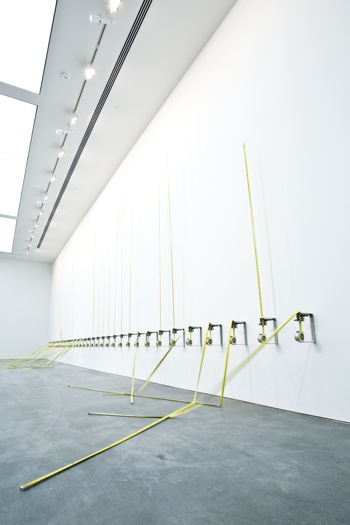
What is it: Rows of motorised measuring tapes record the amount of time that visitors stay in the installation. As a computerised tracking system detects the presence of a person, the closest measuring tape starts to project upwards. When the tape reaches around 3 meters high it crashes and recoils back. 

Technology: Camera, Stepper motors

Field: Tracker, Robotic


Value: It gives an interesting mapping between time and distance. However, the action of crashes seems unreasonable because it cuts visitors' time of stay into pieces for no reason. Also, the tape's falling cause people to dodge and scare them off, which makes no sense unless the inventor do not want a stayer. I come up with an idea to use this phenomenon to do something positive to people's health by encouraging them to move around after a long period of unhealthy working. The natural falling ability of the increasingly long tape results in an influence of people's unconscious level, which makes people to dodge. And it ends up with a healthy break. I want to make it in the class.

Project #2 : Voice Tunnel


What is it: “Voice Tunnel” is a large-scale interactive installation which transfers people's voice into the nightspots in a dark tunnel in the New York City. To use it, people press a button to record his/her voice and the light is lightened according to the volume of that voice in realtime. The voice is stored and played until the next player.

Technology:Voice recorder, Theatrical light

Field: Interactive Sound Light


Value: I thought it is just a magical visual design until I heard many positive voice recorded. People are so eager to have their voice heard or their mood expressed and the dim environment provides they a wonderful place to do so. The voices make the tunnel a narrative and a place full of story. Also, seeing others' light and others' voices can make them feel connected. That is truly a great feeling for people living in a big city.

Monday, October 7, 2013

Whisker from V1 to V4 Meng and Yang


Whisker V1: 


When we first got the topic of whisker, the ideas comes to us are using a straight lines or strings as sensors to do something. Then we developed our whisker project into a paper-based puppet face which has strings as its whiskers. And we pull those whiskers in different ways to deform the paper face, which changes the shadow of it as well. Though the deformation of paper is tiny, the deformation of its shadow is considerable. Also we were interested by the varieties of different expressions a expressionless mask can provide when manipulated by users.

Materials:
  • Papper
  • String
  • Light


Whisker V2:

In the second version of our whisker project, we were limited by the idea of using the laser cutter to do something. Thus we created a black mask which can change its holes by mechanical structure such as level principle and fixed pulley. However, the poor manufacture made it fragile and decrease the interest users want to try it. Also its acrylic appearance makes it very heavy and cumbersome. Therefore we decided to go back with deformation of light material. Liang gave us a great idea to try with silicon. So we did.

Materials:
  • Acrylic
  • String


Whisker V3:

The third version of whisker project improved our understanding of what deformation can do. We made a silicon face with no expression, however, when pulled, it creates lots of different exaggerated expressions. Very interesting! Then we acquired a lot of advices such as making not only flat faces but also 3D structures; making parts of faces such as eyes and mouses rather than the whole face. When demonstrating this device we found the problem of overheat of solenoid. We tried to fix this problem by decreasing the size and thickness of the face and use smaller solenoid. Also we were give lots of useful advices to show off the electronic parts.

Materials:
  • Silicon
  • Hard paper
  • Arduino
  • Distance sensor and Microphone
  • Solenoid
  • String


Whisker V4:


Here comes our V4 of the whisker project. When developing our project with solenoid, we found that it can not only provide stroke but can also cause some interesting movements in silicon such as shaking. Therefore we made use of this effect and developed the final project to be an Extremely Timid Face.

When some one put their face close to the silicon face, it starts trembling. Then we get closer, it trembling harder and end up with a freeze with a expression of horror. We also decrease the size of the shell to make it stable and simple. Last but not least, we took jake's advice to show off the electronic components by using transparent acrylic materials and also using the sound of solenoid as its sound output. 

We are also trying to make a mask with shell which can be directly manipulated by users. And with projectors, the expression of that mask can be exaggerated and amplified.

Materials:
  • Silicon
  • Acrylic
  • Arduino
  • Distance sensor
  • Solenoid

Saturday, October 5, 2013

LookingOut 4 Yang

Project#1  St. Louis Metro: Linear Accelerator 
from Tellart


What is it :
It is a large-scale interactive sculpture for station in St. Louis Metro. With thousands of wirelessly controllable multi-color light notes and a camera, the device transformed passengers' movement into entertaining light shadows.

Technology: 
Structure, LED, Computer vision

Field: 
Interactive architecture, Urban computing

Value:
It is a great idea to add colorful elements to Metro, because that most Metro environment in USA are gray which gives depressive impression. Moreover, it is important that the regulation of lights is depends on input from passengers rather than random. The interaction between people and lights makes passengers feel a connection between environment and themselves, which is interesting. I think there are lots of devices which concern about urban computing. And I'm very interested in how they can affect people living in urban areas. Such as the Cell Phone Disco which gives us a feeling that we are not alone and a connection between us and an unseen world. Or devices can give people positive attitude and improve their mood.

Project#2 Huge Giant Virus!! kidding.. It's name is ADA


What is it:
It is actually a giant ballon with charcoals array on its surface. When floating in the room, it draws!

Technology:
Materials

Fields:
Kinetic sculpture, Drawing machine

Value:
In the video I see people gathering around the machine to push it and make drawings in-deliberately. It brings the cooperation out from people! And also I would like to have one of this (with different colored crayons rather than black charcoals) in my living room (if I have one). Just let it draws, and I will get new patterns on my walls every day.


Monday, September 23, 2013

Looking Out3: Yang


Project #1: RayMatic A Thermostat with a Human Face
by CMU CoDeLab


what is it:
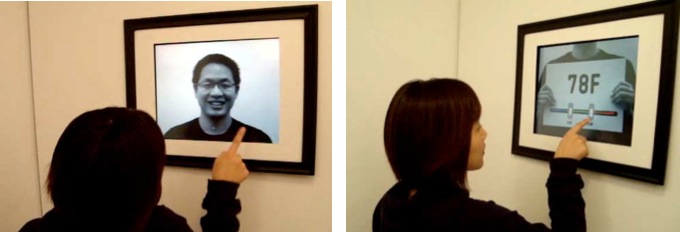
Looks like those photos in Harry Potter movies! RayMatic is a photo frame that holds active photos which can be interactive to people and environment.

technology:
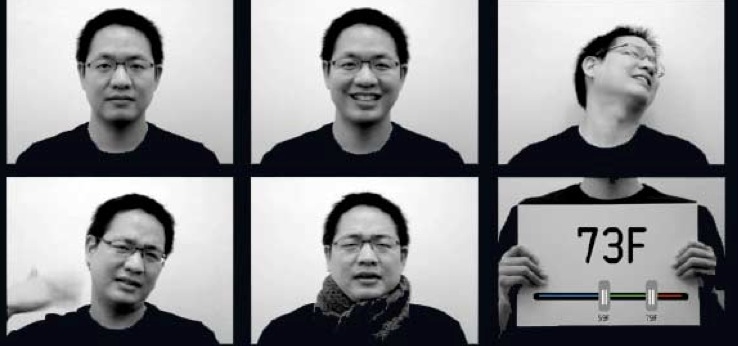
It uses Flash with Actionscript 3.0. The author first took videos of himself and when the system detects a change in temperature through a sensor(LM35DZ) it plays corresponding movies. The 3M MicroTouch M1700SS Display also allows users to interact with the agent in the picture frame by touching.

interaction:
The system can respond to two kinds of input. The temperature and the touch. When the temperature goes up, the figure acts as if he feels really hot and vice versa. Also he can act as being pushed(when touched).


value:
Two major values: First, replacing digital feedback of traditional thermostat makes users feel natural and more willingly to interact with it. Secondly, the way of ambient displays inform people without demanding attention. It is naturally combined with our environment. There are a lots of ambient displays see (http://www.ambientdevices.com)  and they are all seems so friendly and smooth to our living environment. It is really interesting when this nature is combined with human expression and anthropomorphizes. Whether it is an appropriate way to make ambient displays a human-like display and what effect can be generate if we do that are really interesting questions


Project #2: YourGloves, Device to Hold Hand at a Distance
by University of Bath, UK


what is it:
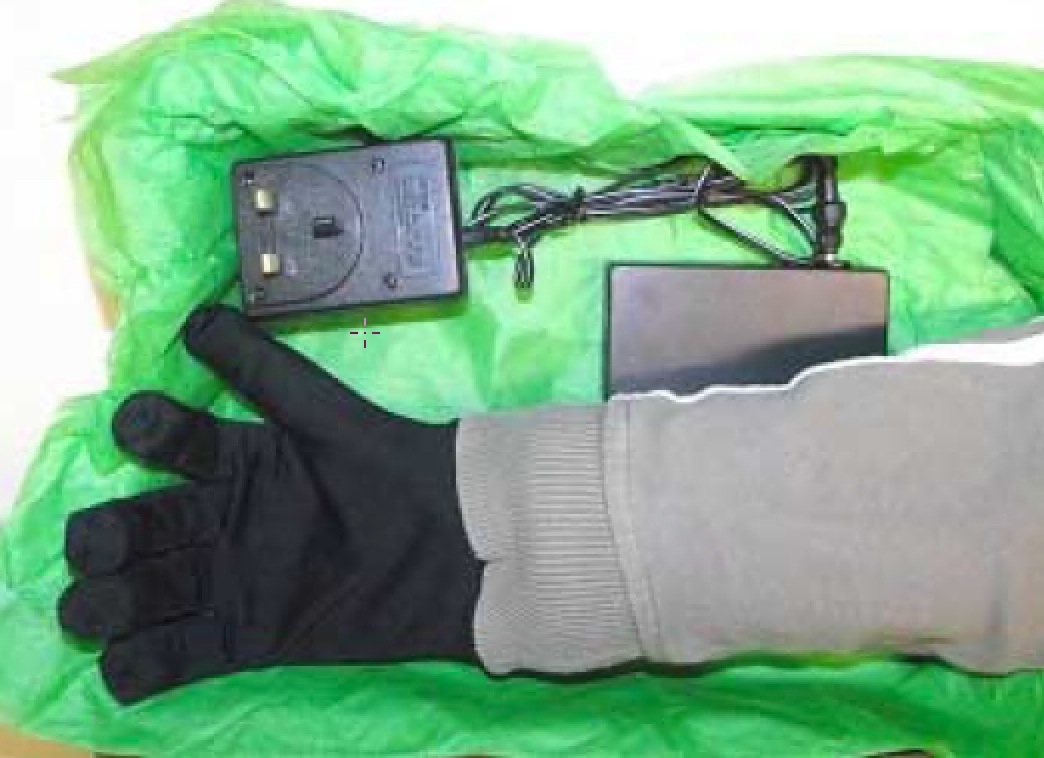
It is a hand-holding prototypes. It should be used in pairs to transfer sense of hand-holding between distant places. According to the author, it is used for support lovers in long distant relationship (I need one!!)


technology:
The hand is made up of a robotic hand controlled by string which, when pulled, cause the hand to contract. The holder's glove is activated by a switch out side the glove. When holder hold the glove, the switch is activated to cause the other glove to contract( this is a little ugly..)

interaction:
Put on gloves, hand holding can be transferred between distant places.

value:
Intimate communication is of great value and is also very interesting for tangible interaction designers. Because that traditional ways of information transformation such as  text messages and phone call or video chat are not tangible, there are great changes for us to design more tangible ways for lovers to communicate each others in distance. This device seems so prototyping but the result published in their paper is that it is of great work to improve lovers' relationship! Cool! What if we make it improved, what if we make it into a face of lover which we can touch and speak to. 

Saturday, September 14, 2013

Looking Out 2: Yang Zhang

Project #1: Sound Brace


what is it:
Soundbrace turns our arm and fingers into an guitar. Wearing it enables you to play music whenever you want even without an instrument.

technology:
it uses sensors as follows: detector to sense the activity of electricity of are muscle; motion capture camera (IR);
Whenever you turn your arm, the muscle produce electricity. By classifying those signals, Soundbrace can know what is the direction of your turn. Also motion capture cameras produce IR so it can tell if a finger blocks IR and the distance between camera and the finger. Thus it can sense the gesture of hand.

interaction:
Play it like playing a guitar but without a real one.

value:
It is a physical-digital devices which augment our daily life. The principle of it is gesture detecting which is hot area of research. Sound brace is just a interesting application of that research. If I'm rich (just a poor student..) I want to buy one to see the instantaneity and accuracy of the brace. However, wether it is good or not, I think, with the development of sensors, I think the physical-digital devices will replace instruments sooner or later and be put into many other applications freeing people from heavy and cumbersome equipments.


Project #2: Digits: Freehand 3D Interactions Anywhere Using a Wrist-Worn Gloveless Sensor


what is it:
Digits is a wrist-worn sensor that recovers the full 3D pose of the user’s hand. 

technology:
IMU, IR Laser Line Projector, IR Camera

interaction:
This technology is used to detect gestures. It can make many applications such as shooting games or virtual reality. Programmers can do a lot of things if they acquire the data of gestures in realtime.

value:
I have seen their demo before so I know its instantaneity is quite well. Without calculating all the depth data of hands, it uses laser lines to get the distance of some points of fingers, which simplifies the computation and raises the speed. At the same time this device is comparatively smaller than some devices (such as Kinect).


Friday, August 30, 2013

Looking Out1:Yang

The first work:


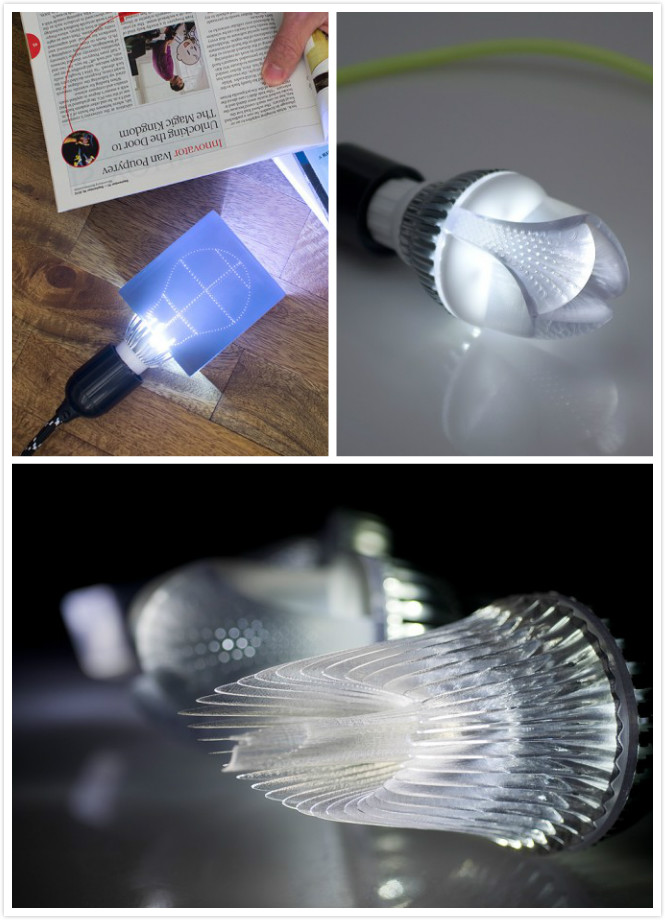
The first work I want to introduce is using 3D printer technology to build bulb. by CMU
Field: 3D print; New output.

Technology: Using 3D printer can easily build structures which can never be achieved by traditional fabrication. The bulb is composed of millions of light pipes in which light can be totally internal reflected.

Interaction: Basically it is a new kind of output without any input, however, the makers made several interesting toys based on this technology. As follows:


A toy can move its eyes when human is being around.

A chess which can show digital information on its surface. It's really cool and may someday change the playing of traditional chess!

Value: I think the kinds of feedback, output of our daily life is increasing with the development with computation ability, material science and fabrication technology. The 3D printed bulb changed the way that we get information from light. Also, the work is exploring the possibility that what we can do with 3D printer in light output. It is just one field of feedback and it will for sure inspire more exploration using this technology to build feedback devices.


The second work:


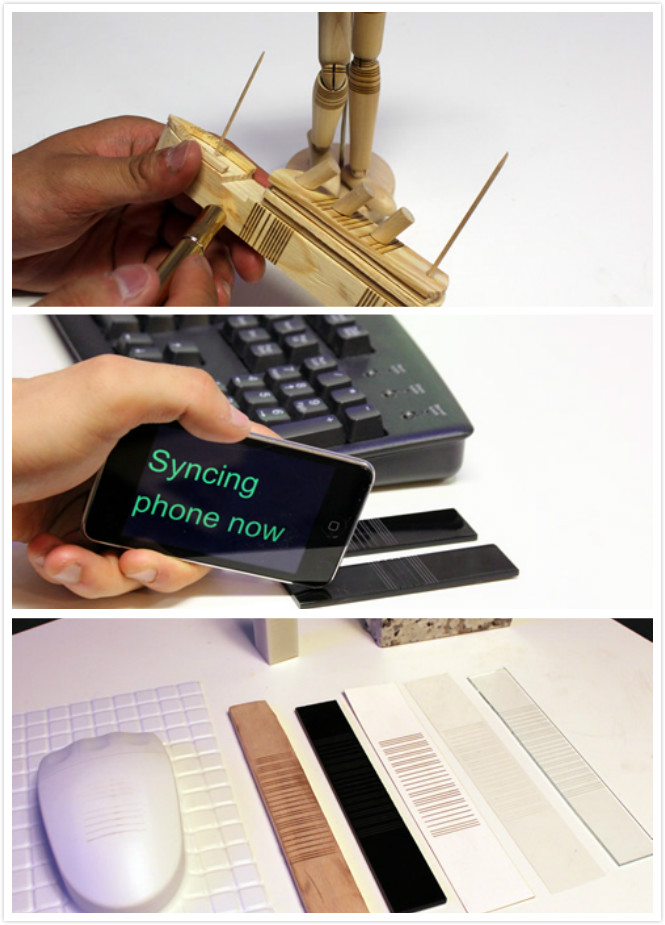
The second work I want to introduce is also from CMU and it is called Acoustic Barcode. It used coded pattern to carry information. When scratched, it makes sound which is binary sequence. A lot of information can be based on binary sequence thus can be based on that acoustic bar.

Field: New input. 

Technology: As the picture shown above, the sound wave is captured by a microphone attached on the surface. Computer will analysis the sound information and translate it into binary sequence.

Interaction: By simply scratch a acoustic bar, computers will know what you are scratching. It has several applications such as museum and classroom.

Value: The work enriches the way of input from physical world to digital world. Though it cannot carry as much information as two-dimension code, it provides users a easy interaction (scratch) and can be easily achieved by using smartphone.

The third work:


The third work I want to introduce is stretchable interface developed by Keio University.  Using Photoreflectors, a normal stocking can be a new kinds of input to detect stretching and can be used in many applications.

Field: New input, IR photo reflector

Technology: When stretched the pattern of a stocking is sparser than not stretched, which allows more transmissivity light go through it. By measure the reflected light, the photoreflectors can tell whether and how much the stocking is stretched.

Interaction: Several applications have been realized by authors, for example the skin of robot. Using this technology, the robot can sense whether it is touched and what is the direction of touching.


Value: I think the stretchable interface gave a good idea of using simple technology to make normal things interactive. Also, the materials they used is quite common and easy to get. The stocking provides natural soft feedback, however, when combined with sensors, it was a novel input method. We should rethink the material in our daily life and try what can happen when they are combined with sensors and the computation.